

Some brands you can find on this website use ‘GOTS certified’ materials. When something is certified, it often already sounds very sustainable, but what does it really mean when something is GOTS certified? This post will give a brief explanation on the origin, meaning and how to recognize a GOTS product.
GOTS stands for ‘Global Organic Textile Standard’, and it is the world’s leading international certificate for the processing of organic fibres to textile products such as clothing.
Organic fibres are natural fibres grown without the use of synthetic pesticides, insecticides, or herbicides and GMOs (Genetic Modified Organisms) according to the principles of organic agriculture.
– GOTS
Organic agriculture is a production process that sustains the health of ecosystems, soils and people
GOTS was founded in 2002 in Germany by four member organizations: OTA (US), IVN (Germany), Soil Association (UK) and JOCA (Japan). After having created their own standards, the organizations came together and combined their standards to create a certificate with internationally recognized standards. Having a few certifications in the world is a lot easier than having different types in each country.
A certificate basically prevents greenwashing, as it proves the production process meets the sustainability standards set by GOTS and there is no way a brand can cheat their way into getting certified.
The GOTS certification is only used for the following fibres:
-
Cotton
-
Wool
-
Silk
-
Flax (linen)
-
Hemp
Criteria
All steps from the processing until the distribution of a textile product are covered by GOTS. If the material itself is sustainable, it doesn’t mean the end-product is, because there are also workers involved who need to be able to produce the product in safe and fair working conditions. Therefore, GOTS evaluates environmental and social criteria. A product can only become certified if all criteria are met.
Below are some key criteria for fibre production, and for processing and manufacturing.
Fibre production:
-
no synthetic pesticides, fertilizers and genetically modified organisms are used during cultivation
-
certification is based on: IFOAM family standards, EEC 834/2007, USDA NOP
-
there should also be a water management plan so not too much water is wasted
-
workers must receive a living wage and work under safe and healthy working conditions
Processing and manufacturing:
Environmental
-
Use of GOTS approved colourants and auxiliaries in wet-processing only
-
Processing units must demonstrate environment management, including wastewater treatment
-
Restrictions on additional fibre materials
-
Environmentally hazardous substances prohibited in chemical inputs
Social
For the social criteria, GOTS uses the sustainability standards of the International Labour Organization (ILO), UNGPs and OECD. The criteria need to be met by all processors, manufacturers and traders. These are a few:
-
Employment is freely chosen
-
Child labour shall not be used
-
No discrimination is practised
-
Occupational health and safety (OHS)
-
Remuneration and assessment of living wage gap
Certification process and audits
When a company wants to be certified, independent third-party certification bodies perform on-site audits to inspect and monitor the production processes. Because these steps are often managed by different companies and organizations, the certification can only apply to one step in the production chain. For example, you have GOTS certified cotton, but also GOTS certified textile factories, weaving mills, sewing factories, etc. That means a garment is only fully GOTS certified if all steps of the chain are certified.
There are 2 label qualities:
- ‘organic‘: ≥ 95% certified organic fibres, ≤ 5% non-organic natural or synthetic fibres
- ‘made with organic materials‘: ≥ 70% certified organic fibres, ≤ 30% non-organic fibres, but a maximum of 10% synthetic fibres
Logo and how to identify a GOTS product
After becoming a member and getting the certification, the logo can be used in emails and on certain products if the supply chain is fully GOTS certified. Product labelling must be approved by the audit organization.
The logo may not be used on a garment if the certificate only applies to part of the supply chain.
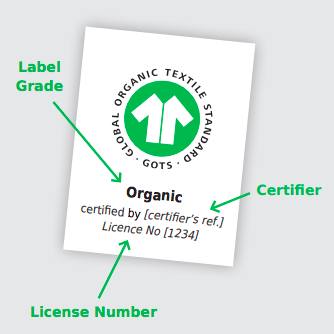
A GOTS certified product can be identified by the logo, followed by the label grade (1 or 2), the certifier who checked it and the licence number, as shown in the image below.
Conclusion
In short, when a fabric or product is GOTS certified, it means the textile product contains at least 70% certified organic fibres, is produced organically and meets requirements that cover the entire production process, both socially and environmentally. In order for a product to carry the GOTS label, all steps in the production process need to be individually assessed and certified.
All information was obtained from the official website of GOTS.
Brands who use the GOTS certification
Some brands who use GOTS are shown below. You can find more brands by typing ‘GOTS’ in the search bar.

Bhumi

Thought

Studio Bohème